What Zero Trust Actually Means for Identity Teams
What Is It?
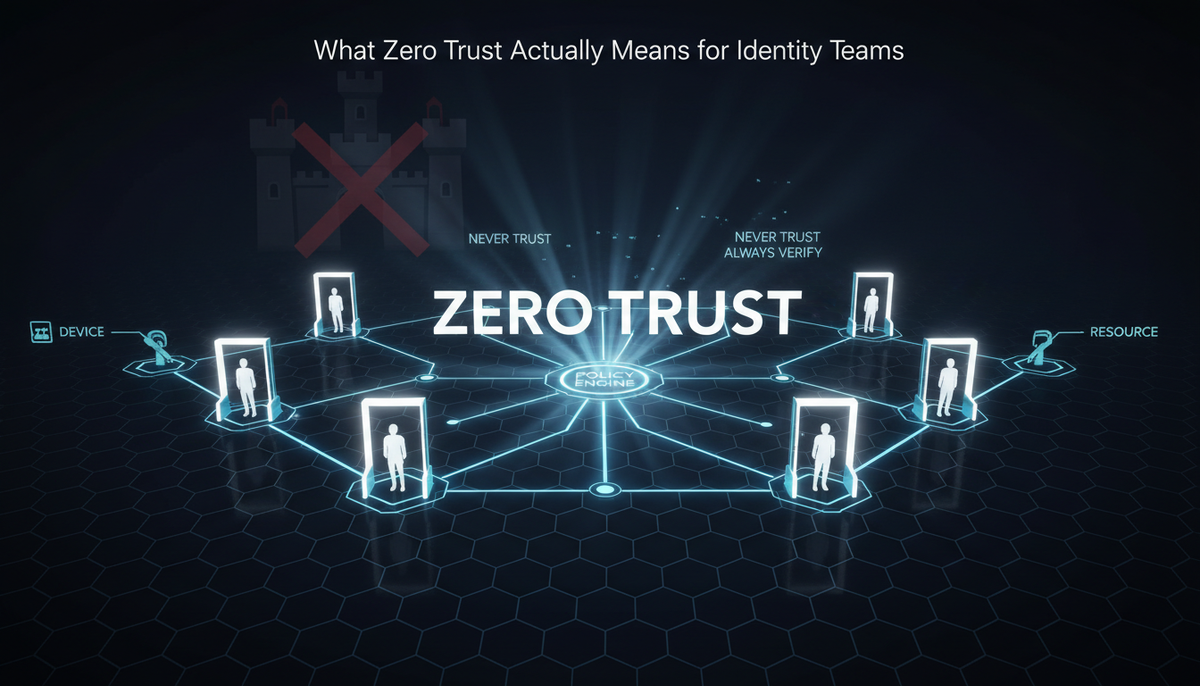
Zero Trust is a security model built on the principle of never trust, always verify. Originally coined by analyst John Kindervag in 2010, Zero Trust rejects the assumption that anything inside a corporate network should be trusted by default. Every access request — regardless of origin — must be verified before access is granted.
For identity teams specifically, Zero Trust means one thing above all else: identity is the new perimeter. The network boundary is gone. The cloud is everywhere. The only consistent enforcement point left is identity.
Why Does It Matter?
The legacy security model assumed that the firewall was the perimeter. If you were inside the network, you were trusted. That model has failed — repeatedly and catastrophically. Ransomware moves laterally inside trusted networks. Compromised VPN credentials give attackers full network access. Remote work erased the network boundary entirely.
Zero Trust doesn't try to rebuild the perimeter — it eliminates the concept of perimeter trust altogether. Every user, device, and application is treated as potentially compromised until proven otherwise, on every single request. This is where identity teams become the most critical security function in the organization.
How Does It Work?
Zero Trust is built on three core tenets, and identity underpins all three:
1. Verify Explicitly
Don't trust a user just because they authenticated once. Continuously evaluate identity signals — who they are, what device they're using, where they are, what they're trying to access — on every request.
Identity role: Strong authentication (MFA, passwordless), Conditional Access, Identity Protection risk signals.
2. Use Least Privilege Access
Grant only the minimum access required. Time-bound, scoped, just-in-time wherever possible.
Identity role: RBAC, PIM, Entitlement Management, access reviews.
3. Assume Breach
Design controls as if the attacker is already inside. Limit lateral movement. Minimize blast radius.
Identity role: Separation of duties, privileged access controls, audit logging, anomaly detection.
Real-World Example
An organization adopts a Zero Trust architecture. Their starting point is identity:
- All users are required to authenticate via Entra ID with MFA
- Conditional Access enforces device compliance before granting access to corporate apps
- Privileged roles are managed via PIM — no standing admin access
- Access reviews run quarterly across all sensitive systems
- Sign-in risk is monitored continuously via Identity Protection
Six months in, Identity Protection flags a sign-in from a compromised account. The risk score triggers Conditional Access to block the session and force a password reset — automatically, before the attacker reaches a single resource. Zero Trust worked.
Best Practices
- Start with identity — not network — it's the fastest path to meaningful Zero Trust progress
- Enforce MFA universally as your baseline verification control
- Define your sensitive assets and enforce stricter controls around them first
- Use Conditional Access as your policy engine — it's how Zero Trust becomes operational
- Monitor continuously — Zero Trust isn't a configuration, it's an ongoing posture
- Treat Zero Trust as a journey, not a destination — no organization achieves it fully on day one
Key Takeaway
Zero Trust isn't a product you buy or a checkbox you check. It's a security posture — and for identity teams, it starts with one decision: stop trusting by default and start verifying everything.
Quimirr Heyward is an IAM specialist with 7+ years in Risk Management and Compliance. He writes about identity security at QuimirrHeyward.com.